
Ingredients
Black Cardamom: Meet Green Cardamom’s Smoky Cousin
Get to know black cardamom, its Himalayan background, smoky flavour, uses in curry and breyani, and why green cardamom is not the same spice.
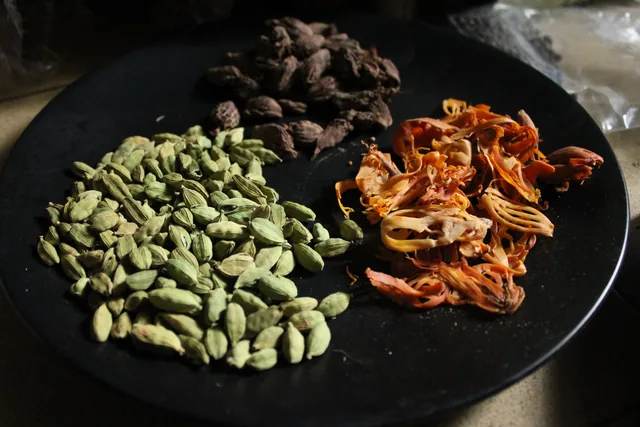
Black cardamom arrives looking as though it has already spent the afternoon beside the cooking fire. Its large, wrinkled pods are a world away from the tidy green ones in the next jar.
Open the packet and the difference becomes clearer. There is a deep, smoky character that suggests a substantial meal. This is a spice worth getting to know on its own terms, especially if you enjoy a richly seasoned pot of meat or breyani.
A different member of the family
The South Asian black cardamom discussed here is Amomum subulatum, also called large cardamom. It is a separate species from green cardamom, not a green pod that has simply ripened or gone stale. Kew distinguishes the two and notes large cardamom’s use in meat dishes and pickles.
Names can be confusing at the spice counter. Look for black or large cardamom intended for South Asian cooking, and tell the seller what you are making. A clear label is more helpful than assuming everything called cardamom tastes alike.
From Himalayan fields to the cooking pot
Large cardamom has a strong association with the northeastern Himalayan region, including Sikkim. India’s spice research institute describes it as an important crop of that region. ICAR-IISR’s large-cardamom profile provides the agricultural background.
Part of its familiar character also comes from processing. Traditional drying in a wood-fired bhatti exposes the pods to smoke; drying technologies that separate the smoke produce a different result. India’s university teaching material on cardamom drying explains those methods.
So that smoky note is not a signal to burn the spice again in your pan. The grower and processor have already done their part. Your job is to give the pod a suitable home in dinner.
How to use the pod
Let the recipe guide whether the pod stays whole, is lightly opened, or has its seeds ground into a blend. Those approaches leave different textures. A whole pod can be lifted out; ground seeds become part of the seasoning.
If opening a pod, press it just enough to split the husk. There is no need to scatter woody shards through the gravy. Remove whole pods before serving where practical, and mention them to anyone unfamiliar with whole spices.
In our biryani for lamb or chicken, the dry spices are roasted and ground. Black cardamom appears beside green cardamom, cumin, coriander, fennel and cloves. That is a useful example of both cardamoms being included deliberately, rather than one standing in for the other.
Where that deep flavour belongs
For a local starting point, try our Chicken Breyani, which specifies one black elachi. The rest of the recipe gives it plenty of company: rice, chicken, lentils, ginger, garlic and other aromatics.
Or look at Aunty Maurine’s Durban Mutton Curry. Its whole breyani mix includes black and green elachi alongside fennel, cinnamon, cloves and star anise. These are contributor recipes with their own balances, not evidence that every Durban curry needs exactly the same mix.
Cumin’s earthiness and ginger’s lively flavour are useful directions to explore around that smoky base. Start with an existing recipe and notice the result before improvising.
What can go wrong?
The most common misunderstanding is treating black cardamom as green cardamom in a darker coat. In a delicately perfumed dessert, its smoky character changes the whole idea. It may be an experiment you enjoy, but it is not a neutral substitution.
The same applies to quantity. Bigger pods do not call for a more generous handful. Keep to the stated amount for the first cook, especially when a masala already contains several powerful aromatics.
If you cannot find it, a recipe designed without black cardamom is often a better starting point than assembling an elaborate imitation. You can still make a satisfying curry; you will simply be making one with a different balance of flavours.
Health claims need the right plant
Black cardamom has been investigated in laboratory research, including a study of extracts and antimicrobial activity. Results from those experiments do not establish that eating the spice treats an infection. Nor can findings about green cardamom automatically be assigned to this different species. The laboratory study is useful for understanding that distinction.
A small packet, properly kept
Keep the pods in a tightly sealed container in a cool, dry cupboard. Close the packet promptly after measuring. General spice-storage guidance applies here too.
Black cardamom need not appear in every meal. The pleasure is recognising when that darker, smokier note is exactly what the pot calls for.